"I wanted to make the murder inevitable without any blame attaching to the woman. I wanted to preserve sympathy for her, so that it was essential that she fought something stronger than herself."
--Alfred Hitchcock
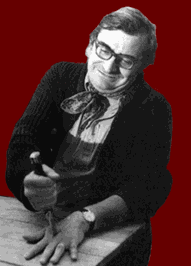
Alfred Hitchcock made this statement back in 1938, but it could almost as easily have been made by the Hitchcockian influenced, but finally rather dissimilar, Claude Chabrol. With Eric Rohmer, Chabrol co-wrote a book on Hitchcock in 1957, and throughout this French filmmaker's work we find characters at the mercy of passions deeply embedded by the social norms they live by. However, if the sympathy Hitchcock talks of is always at one remove in Chabrol, it is because Chabrol deals with characters who are frequently rich and stultified by social mores: one's initial reaction to their misery is to gloat, rather as one might read a tabloid piece about a celebrity's crimson bank balance.
Yet if Chabrol is apparently tabloid in theme, his style has frequently been sophisticated and languorous -- a slow burn examination of his characters' lives with a rapt, patient camera. Consequently place is of immense importance. Britanny, Massif Central, the Loire Valley, out of season St. Tropez: many a region, small town or village has been focused upon, not simply utilized. In maybe his finest film, Le Boucher, Chabrol gives an onscreen credit to the Perigaud valley villagers who give the film so much of its atmosphere. Even Chabrol's houses are memorable and significant. The stretched, low slung and vaguely Americanized abode in La Femme Infidèle; the minor chateaus of Wedding in Blood and La Cérémonie, each isolated and aloof; the marvelous convivial country house in the early stages of Un Partie du Plaisir, and the nouveau riche home of the garage owner in The Beast Must Die all indicate characters inextricably linked to the place in which they live. A man's home is almost literally, in Chabrol, his castle, and it is equally true that the castle is the man.
Lest we are in any doubt, watch how Chabrol subjectifies the camera even when not utilising point of view. In La Cérémonie, for example, where swift, darting camera pans have all the admiring envy of a petty bourgeois social climber. When a character finally passes comment upon the property, its pleonastic: the camera's already done all the work for us. However, the repetition suggests the depth of envy. If the camera indicates a keen interest, the words of the lowly postal clerk Jeanne give the film a murderous intent. "A la la ... now there's class for you," she says on seeing the Lelièvres' family home. Teamed with the family's maid, Sophie, Jeanne's powder-keg character awaits the fuse of indignation and finds it when Sophie's sacked by this haute bourgeois family. Jeanne returns one evening to the chateau with Sophie, apparently to pick up Sophie's things. They quietly make hot chocolate while the family obliviously watches Don Giovanni in the study. Then we watch as the pair of them creep up the stairs, pour hot chocolate over the master bed, and rip the wife's clothes to shreds.
| View Jeanne (Isabelle Huppert) and Sophie (Sandrine Bonnaire) from La Cérémonie |
Jeanne and Sophie then go downstairs, where the music-loving factory-owning father, his second wife, her son, and his daughter are promptly dispatched with their own hunting rifles.
La Cérémonie is simultaneously overwhelming -- the violence is vividly depicted -- and inevitable. In scene after scene, Chabrol builds up motive. Sophie is treated with a mixture of disdain and smug paternalism. We see her alone in the kitchen, plucking the remaining flesh off the family's eaten chicken carcass. As she does so, she's called to clear the plates. Driving lessons and glasses are suggested to her no matter the resistance, and the wife, Mme. Lelièvre, casually touches Sophie's shoulder in a gesture that would be socially violating if reciprocated. The most telling scene, however, is when daughter Melinda discovers Sophie's illiteracy, and she states, more than once, "there is help for people like you."
What we have in La Cérémonie is the coming together of Hitchcockian sympathy and Chabrolian materialism. Chabrol asks us to empathize with two characters who are both deceitful and selfish, and who live by a mixture of fear and envy. He achieves this empathy first and foremost by the most obvious of devices: unsympathetic victims. But that isn't where the film's inevitability lies. Chabrol conveys to us the degree to which the victims' lives are imbibed by tradition. Early in the film the father mentions to the rest of the family, Sophie's lack of silver service skills. We watch as dinners, parties, and television concerts are turned into rituals; throughout we watch the complete complacency central to the wealthy characters' lives.
If we finally care for Sophie and Jeanne, it isn't for anything intrinsic in their characters; it's because of what they represent. They are finally no more agreeable than the film's rich characters, but the camera's alert eye shows us people sutured in their own wealth and contrasts them with others adrift in their own poverty. We sympathize with Sophie and Jeanne for essentially political reasons. If Chabrol consistently shows us characters whose property and wealth so clearly define their identities, then what about those characters who have no property and no wealth?
Bertrand Russell believed "envy is ... one of the most universal and deep-seated of human passions ... it is the basis of democracy." Chabrol shows us this curious process of social awakening not only in La Cérémonie, but also in Les Biches and Les Bonnes Femmes, Innocents with Dirty Hands, and Madame Bovary. Indeed, in one form or another in almost all his work. But he also illustrates how hampered this social awakening is by cramped social expectation and personal neurosis. If characters like the Leliévres, Les Biches' rich bi-sexual Frédérique, and the small town mayor and businessman in Wedding in Blood can define themselves at relative will, no such freedom is offered to the films' less wealthy characters.
In Les Biches, the young street painter "Why" is a virgin picked up by businesswoman Frédérique, initiated into sex, and taken away to Frédérique's villa in St. Tropez.
| View Why (Jacqueline Sassard) and Frédérique (Stéphane Audran) from Les Biches |